Een aandachtige lezer van onze Rockoxbiografie zond ons deze foto van Mespelare, het dorp bij de Dender, waar dagloner Karel Van Houw op een koude ochtend in april 1607 kolen ging planten in zijn tuin en al gravend een enorme schat aan Romeinse gouden munten ontdekte. Een deel van de schat zou uiteindelijk in de verzameling van Nicolaas Rockox terechtkomen, die het aan het eind van zijn leven zelf weer doorverkocht aan Gaston d’Orléans, de broer van de Franse koning Lodewijk XIII.
Mespelare heeft nog steeds een mooie dorpskern en een opvallende kerk, die in de loop van de zeventiende-eeuw een bedevaartsoord werd voor de H. Aldegondis. In december 1607 maakte het dorp nog iets bijzonders mee: de jonge dichter Justus de Harduwijn werd er tot pastoor benoemd en zou de rest van zijn leven in deze omgeving slijten.
De fotograaf schreef: “Zo moet Mespelare er in de zeventiende eeuw ook ongeveer hebben uitgezien, vanuit de verte.” En inderdaad, ik stel me voor dat een ruiter toen het dorp zo aantrof, op de recente gracht na. Er reden veel ruiters naar Mespelare, na de ontdekking van de schat…
(Mijn honderdste bericht: ik zal het vieren met een zondags gebakje.)
Een Engelstalige bespreking van Rockox. Burgemeester van de Gouden Eeuw door een andere lezer vindt u hier.
Op een druilerige junidag is het moeilijk om zich de hooioogst voor te stellen. De onbekende kunstenaar die in de jaren 1440 het werk van de gebroeders van Limburg aan de Très Riches Heures voortzette, situeerde zijn hooiende boeren en boerinnen aan de oevers van de Seine, net buiten Parijs. We zien de torens van het koninklijk paleis en rechts het grote roosvenster van de Sainte-Chapelle, op het Île-de-la-Cité. Mooi ook, dat prieel in de koninklijke tuinen. De schilder liet ons twee bijzonder gracieuze blootsvoetse boerinnen na. Zo vinden we in dit aristocratische kunstproduct bij uitstek een beeld van het volksleven, net zoals we bij kroniekschrijver Jean Froissart, op het eerste gezicht een sportverslaggever van riddertornooien, soms onvergetelijke beschrijvingen van de daden en woorden van gewone burgers lezen.
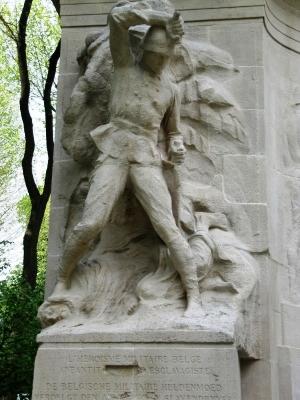
“Het monument ‘De Belgische pioniers in Congo’ in het Jubelpark zorgt voor commotie, ” lees ik in mijn ochtendkrant. Om de waarheid te zeggen wist ik niet dat dit monument bestond, maar wat ik wel weet, is dat mijn overgrootvader in 1893 een Belgische pionier in Congo is geweest. “Aan de zijkant van ‘De Belgische pioniers’, gebouwd in 1921, is te zien hoe een Belgische soldaat een Arabier het hoofd intrapt. Het tafereel heeft als bijschrift ‘De Belgische militaire heldenmoed verdelgt den Arabischen slavendrijver’. Volgens Ecolo stoot de islamofobe tekst de moslimgemeenschap tegen de borst. ‘Deze zin heeft Brusselaars van Arabische afkomst geschokt,’ zegt Brussels parlementslid Ahmed Moussin.” (De Standaard, 16 juni 2011, p. 11.)
Islamofoob – met angst voor de islam. Het is me niet duidelijk waar er uit dit opschrift angst voor de islam spreekt. Wellicht bedoelt Ecolo, niet erg bekommerd om etymologie, met ‘islamofoob’: ‘getuigend van afkeer, of vooringenomenheid, jegens de islam’. Ook dat lees ik niet in dit opschrift. De tekst verwijst slechts naar ‘den Arabischen slavendrijver’, en dus naar een economische activiteit, niet naar een religieuze overtuiging. Stuit Brusselaars van Arabische afkomst dan de (historisch correcte) vermelding tegen de borst dat er Arabische slavendrijvers actief waren op het Afrikaanse continent en dat die hun jachtterrein in Congo kwijtraakten? Als met de Brusselaars van Arabische afkomst Saoedi’s bedoeld worden, mag men er misschien op wijzen dat de slavernij in Saoedi-Arabië pas in 1962 officieel werd afgeschaft (en nog steeds lijkt te bestaan). Als er Brusselaars van Marokkaanse origine mee bedoeld worden, kun je je afvragen waar zij zich druk om maken.
Het beeld past bovendien in de allegorische traditie: er zijn geen concrete mensen voorgesteld, maar personificaties. De soldaat symboliseert “de Belgische militaire heldenmoed”, de liggende Arabier de slavenhandel. En wordt hier wel echt een hoofd “ingetrapt”?
Zullen Brusselaars van Arabische afkomst binnenkort ook verzet aantekenen tegen het standbeeld van Godfried van Bouillon? Of aan de mededeling in de geschiedenislessen dat Karel Martel in 732 bij Poitiers de Arabieren versloeg?
Wees op uw hoede voor politieke correctheid, zij leidt tot geschiedvervalsing.
Een verhelderend negentiende-eeuws citaat: “During the present century, many circumstances have combined to make the Zanzibar Arabs the most noted slave-hunters and slave-dealers in the world. Of their earlier history little is definitely known, beyond the fact that already in the tenth century there were Arab settlements along the East Coast of Africa.
After the discovery of the Cape Road to the Indies, most of these settlements were conquered by the Portuguese, and were then gradually reconquered in the eighteenth and beginning of the nineteenth centuries by the Imams of Muscat.
Of this second Arab dominion the most important centres were the islands of Zanzibar and Pemba; and from these islands, as the result of the mingling of Arab and negro blood, a race of black Arabs has sprung. Yet, despite their long occupation of the Zanzibar coast and neighbouring districts, it is only within recent recent times that the Arabs have advanced into the Interior.
Some two generations ago the island of Pemba developed into a great clove-plantation, worked by slaves in the manner of the cotton and sugar plantations of America. A little later, certain merchants of Zanzibar, becoming involved with their creditors, migrated to Central Africa to prospect for ivory. Owing to the destruction of their beasts of burden by the tse tse fly, they found it necessary to employ the natives as porters; and thus it arose that blacks were shipped to the Zanzibar slave-market, as a by-product of the ivory trade, at the very time there was a strong demand for their labour in the clove-plantations of Pemba. The supply of slaves ultimately became such as to permit of a large export across the seas to the Mohamedan countries of Asia.”
Sidney Langford Hinde, The Fall of the Congo Arabs, Londen, 1897, p. 2-3.
Mijn moeder had me gewezen op enkele ondiepe kuilen in de tuin: “Hier slapen ’s nachts reeën”. Het leek vreemd dat deze schuwe dieren in de buurt van een woning zouden willen overnachten, in plaats van in de nabije dennenbossen vol beschuttend onderhout. De volgende dag zag ik hen, tijdens een wandelingetje naar de tulpenboom. Uit een aanpalende weide sprongen ze verend de tuin en hielden toen halt op het pad, om naar me te kijken: een reegeit met twee mooie kalfjes. Ik kon mijn ogen amper geloven, en deed het toch. Daarna snelden ze verder, naar het bos.
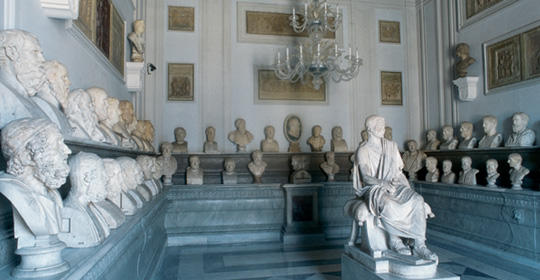
Homerus hoort erbij (hij verklaarde een hele heldenoorlog al in zijn eerste versregel tot een uitvloeisel van ordinaire wrok), dan zijn er Socrates de lelijke, Plato de brede, Democritus de lachende, Epicurus de mooie… Athene, bewaard door Rome.
Epicurus van Samos, leunend tegen zijn leerling Metrodorus, Louvre, Parijs
Uit Epicurus’ brief aan Menoikeus: “Wanneer wij dus zeggen dat lust ons levensdoel is, hebben wij het niet over de lust van losbandige lieden of over de lust die gelegen is in actief genieten – zoals sommige mensen denken die niet weten waar ze het over hebben en die met ons van mening verschillen of aan onze leer een negatieve uitleg geven – maar wij doelen op een toestand waarin het lichaam geen pijn heeft en de ziel niet verontrust wordt. Het gelukkige leven komt niet tot stand door drinkgelagen of onafgebroken feesten, noch door het genieten van jongens of vrouwen, of het eten van vissen of andere spijzen die de rijk voorziene tafel biedt, maar door nuchter denken, dat niet alleen de gronden onderzoekt van elk kiezen en vermijden, maar ook de ongegronde meningen uitbant waardoor de grootst mogelijke onrust zich van ons meester maakt.”
Epicurus, Over de natuur en het geluk, vertaald, ingeleid en van aantekeningen voorzien door K. Algra, Historische Uitgeverij, Groningen, 1998, p. 132.
Zie ook de inleiding tot Epicurus bij Moraalmarokkaan:
L. Cogniet, Mijn kamer in Villa Medici, Rome, 1817 (Cleveland Museum of Art)
Een zelfportretje van de jonge Léon Cogniet, die net de Prix de Rome had gewonnen, een studiebeurs voor vijf jaar verblijf in de Franse Academie in Rome. Hij is bezig zijn kamer in te richten, zijn gitaar heeft al een plaats gevonden. Buiten wenkt het licht op de Pincio. Wat een heerlijk gevoel moet dat zijn geweest, weten dat dit mooie avontuur net begon.
(Tot 4 juli te zien in Rooms With A View, Metropolitan Museum, New York)
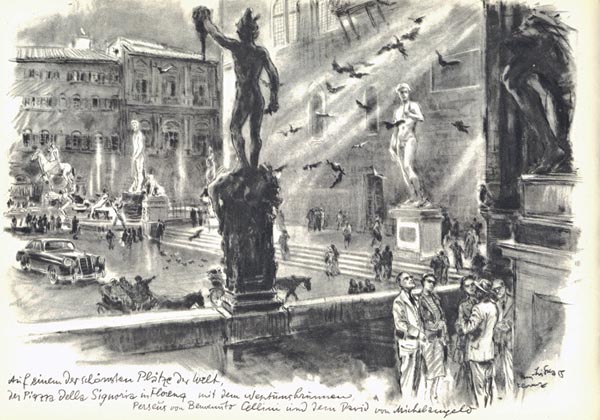
De Oostenrijkse illustrator Hans Liska (1907-1983) specialiseerde zich in de weergave van voertuigen en werkte in de jaren 1950 meermaals voor Daimler-Benz. Deze tekening is typisch: we zien waar hij zijn favoriete wagen heeft achtergelaten, tussen de voetgangers en de koetsen op de Piazza della Signoria in Florence, en we zitten bijna samen met hem in de Loggia dei Lanzi de rug van Cellini’s bronzen Perseus te bewonderen. Een dynamische, haast hyperkinetische tekening van een man die Picasso, Ernst en Kokoschka vereerde.
H. Liska, Den Herzen hinter dem Stern, Stuttgart, 1955.