“Als ik de middelen had, zou ik zoals Jean des Esseintes het huisje helemaal en uitsluitend inrichten naar mijn behoeften en wensen. Weet je nog, de muren van zijn bibliotheek waren bekleed met oranje marokijnleer en indigo lak, een ander vertrek was ingericht als een kajuit en de badkamer als de werkplaats van een parfumeur? Hij noemde zijn droomhuis in Fontenay zijn Thebaanse hermitage.”
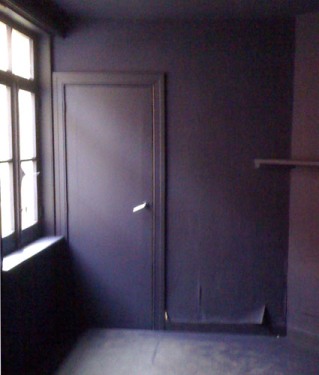
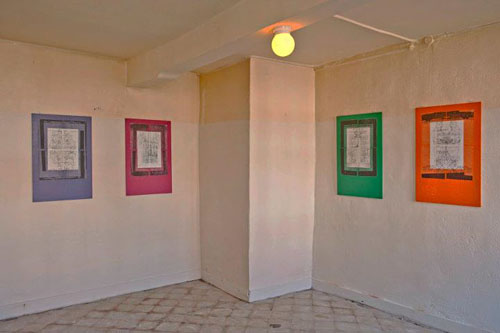
Het deed me wonderlijk veel genoegen, dat Anne-Mie Van Kerckhoven zich door deze zin uit Genius Loci liet inspireren om twee ruimtes in het Turnhoutse Begijnhofhuisje 21 van kleur te voorzien.
De tekeningen van AMVK in het Turnhoutse begijnhof (foto Frederik Beyens)
“Het is een mooie poort.”
In de saaie straat viel het poortgebouw op. Klassieke, breed uitgezette lijnen, een nis met een borstbeeld, symmetrie, leistenen en kasseien – al de elementen die dienst kunnen doen als tijdmachine en Belgen terugvoeren naar de tijd van waarin de laatste glans van de gouden eeuw wegdeemsterde, Rubens en Van Dyck al tachtig jaar dood waren en iedereen die vijf goudstukken bezat zich schikte in een bestaan als rentenier. Twee vergulde bollen bekroonden het dak en voerden de geest zacht naar de gedachte aan landhuizen in Frankrijk.
Door de halfgeopende groene poort keken we naar binnen. Een ovaal van huizen rond een parkje, waarin een soort Golgotha oprees, bekroond met een kruisbeeld.
We betraden het begijnhof. Is er iets gewoners dan een begijnhof? ‘Begijntjes en kwezelkens dansen niet,’ zongen wij als kinderen, er waren begijnhoven in alle omliggende stadjes (hoewel nog slechts een of twee begijnen) en uit verveling las je in de zomervakantie wel eens ‘De zeer schone uren van juffrouw Symforosa, begijntje’, de novelle van Felix Timmermans. Lezen gold overigens ook als een kwezelachtige activiteit, in sommige kringen.
Een fragment uit het verhaal Genius Loci, dat ik schreef bij Anne-Mie Van Kerckhovens tekeningenreeks Heiligen en Begijnen, nu te bezichtigen in huisje 21a van het Turnhoutse begijnhof.
Het boek met de tekeningen en de verhalen wordt morgen voorgesteld in de Meerloop in het Begijnhof. Allen hartelijk welkom!
(Het boek, gedrukt in een oplage van 500 exemplaren, is te koop in de Warande in Turnhout, boekhandel Copyright in Antwerpen, de boekhandel van het Museum Aan de Stroom in Antwerpen en in Kunstmuseum aan Zee in Oostende.)
“De jonge Van Schelle groeide in die welige natuur op tot een frisse knaap, die zoals we later zullen ervaren, graag haantje vooruit was.
Vader Van Schelle was een goedig maar zwaarlijvig man die tamelijk moeilijk uit de voeten kon, en alhoewel begaan met de opvoeding van zijn telg, het niet kon bolwerken. Zijn moeder, die heel veel afwezig was, kon zich nog minder met de opvoeding van de knaap inlaten.
Vanzelfsprekend dat de opgroeiende Martial, én van de ene én van de andere toestand, profiteerde en deed wat hij graag deed en de rest liet voor wat het was. Maar wat hij deed was kattekwaad.”
Zo erft men dan een held, via grootvader en vader.
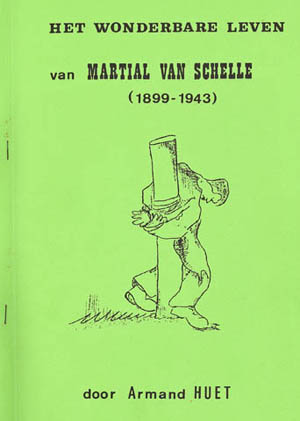
Die verroeste nietjes ontroeren me. Maar het is tijd voor een met foto’s geïllustreerde editie, en een nieuwe lay-out, tegen de Erfgoeddag.
It was that topsy-turvy product – an ‘exclusive’ commercial enterprise. That is, it was a thing which paid, not by attracting people, but actually by turning people away. In the heart of a plutocracy tradesmen become cunning enough to be more fastidious than their customers. They positively create difficulties so that their wealthy and weary clients may spend money and diplomacy in overcoming them.
It is the combination of modern humanitarism with the horrible modern abyss between the souls of the rich and the poor. A genuine historic aristocrat would have thrown things at the waiter, beginning with empty bottles, and very probably ending with money. A genuine democrat would have asked him, with a comrade-like clearness of speech, what the devil he was doing. But these modern plutocrats could not bear a poor man near to them, either as a slave or as a friend. That something had gone wrong with the servants was merely a dull, hot embarrassment.
Ik meende een ontspannend verhaaltje over Father Brown te lezen, nu zit ik me af te vragen waarom deze zinnen uit Father Brown and The Queer Feet zoveel weerhaken bevatten. Zinnen uit 1911.
En is het werkelijk zo dat niemand ooit postbodes opmerkt? Dat zou kunnen verklaren waarom de jonge postbode in mijn straat er altijd zo ongelukkig uitziet.
G.K. Chesterton, The Innocence of Father Brown, Penguin Books, 26ste druk.
Vanavond in de Sint-Antoniuskerk aan de Paardenmarkt (tijdelijk onderkomen voor de protestantse gemeenschap, nu hun eigen kerk, de Brabantse Olijfberg in de Lange Winkelstraat, acuut restauratie behoeft): een liturgische uitvoering van Willem Ceuleers’ nieuwe Johannespassie.
Livina Teerlinck, Witte donderdag met koningin Elisabeth I, Madresfield Court
“Een van de groepsportretten door Levina Teerlinc is bewaard: een miniatuur met de rituele voetwassing door Elizabeth I op Witte Donderdag. Op het kleine werkje, zesenhalve centimeter hoog, beeldde ze tientallen figuren af: vooraan de koningin en haar hofdames met lange schorten aan, langs de zijkanten de arme vrouwen wier voeten zij zullen wassen en achteraan koorzangers en hellebaardiers. Het kleurrijke tafereel valt op door een wat naïeve uitvoering: smalle lichaampjes met dunne armen en grote hoofden.”
De Brugse Levina Teerlinc, dochter van Simon Bening, maakte in de zestiende eeuw carrière aan het Britse hof als miniaturiste. Zo kon zij ook een traditie van Witte Donderdag – Maundy Thursday – vereeuwigen: de koningin waste dan (in navolging van Christus die tijdens het Laatste Avondmaal de voeten van de apostelen waste) de voeten van evenveel behoeftige vrouwen als zijzelf jaren telde.
Tot mijn verbazing bestaat er nog steeds een Witte-Donderdagtraditie in het Verenigd Koninkrijk: de koningin wast geen voeten van onderdanen, maar bezoekt een kathedraal en schenkt Maundy money aan oudere mensen die zich verdienstelijk hebben gemaakt voor de gemeenschap.
L. Huet en J. Grieten, Oude meesteressen. Vrouwelijke kunstenaars in de Nederlanden, Leuven, 1998, p. 113-114.
Ik voelde me als Duimelot, toen ik gisteren een sigarenkistje vond waarin ik zou willen wonen. Het bevatte boekenrekken en boekenkasten, een keurig opgemaakt bed met een kleurrijke gehaakte sprei, een bureau, een lampetkom en kruik, een kandelaar met een kaars en een doosje lucifers van Union Match. Aan de cederhouten zoldering hing een gerookte hesp te drogen. Er was ook een oude schoolprent te zien, waarop de struktuur van de slak werd voorgesteld. Op de rekken achter het bureau stonden geen boeken, maar sigarenkistjes-op-ware-grootte met knipsels, foto’s, kleine verzamelingen. En ik bedacht, hoeveel dingen ik zou kunnen verzamelen als ik nog alle kistjes bezat van alle sigaren die mijn vader en grootvader hebben gerookt. Maar ik ben te ongeduldig om te verzamelen, te slordig om een archief bij te houden, en mijn handschrift is niet klein, ordelijk en ruimtebesparend, maar haastig en groot.
Kaartenhuizen, reuzenlucifers van Union Match, archetypische kopspelden, weckpotten met bonen, encyclopedieën – een Grzimek! -, doppen van bierflesjes: zoveel aan het werk van Patrick Van Caeckenbergh voerde me terug naar ogenblikken van kinderlijke fascinatie en concentratie.
Patrick Van Caeckenbergh, La Ruine Fructueuse, in Museum M te Leuven, tot 22 april.
‘My dear fellow,’ said Sherlock Holmes, as we sat on either side of the fire in his lodgings at Baker Street, ‘life is infinitely stranger than anything which the mind of man could invent. We would not dare to conceive the things which are mere commonplaces of existence. If we could fly out of that window hand in hand, hover over this great city, gently remove the roofs, and peep in at the queer things which are going on, the strange coincidences, the plannings, the cross-purposes, the wonderful chains of events, working through generations, and leading to the most outré results, it would make all fiction with its conventionalities and foreseen conclusions most stale and unprofitable.’
‘And yet I am not convinced of it,’ I answered. ‘The cases which come to light in the papers are, as a rule, bald enough, and vulgar enough. We have in our police reports realism pushed to its extreme limits, and yet the result is, it must be confessed, neither fascinating nor artistic.’
Het doet plezier, Holmes en Watson aan te treffen terwijl ze zich verdiepen in esthestische vragen over de waarde van het realisme. En dat idee, over een stad zweven, alles in ogenschouw nemen en tegelijkertijd doorgronden, dat spreekt vermoedelijk iedere schrijver aan.
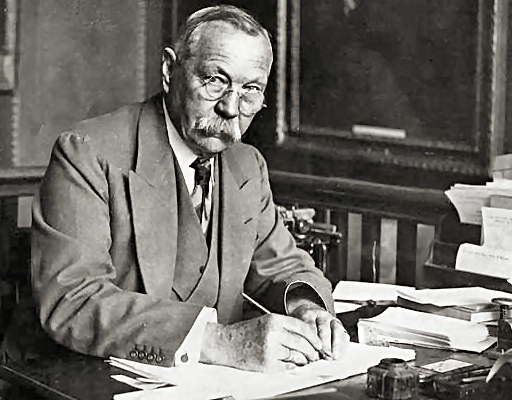
Sir Arthur Conan Doyle, A Case of Identity, in The Adventures of Sherlock Holmes, Laurel Press, Londen, 1987, p. 47.
Twee weken geleden gebeurde er iets ongehoords. Ik zonk neer in de sofa voor de televisie, gewapend met chips en een glas wijn, zoals steeds bereid om het na wat zappen op te geven en naar een boek te grijpen of alsnog een avondwandeling te maken. Toen greep iets mijn aandacht. En meer aandacht. En ik raakte in de ban van het verhaal, de personages, de montage, de decors, de sfeer. Wat ik niet meer verwacht had, vond plaats – ik werd betoverd door een aflevering van een tv-reeks, zoals niet meer voorgevallen was sinds ik, eeuwen geleden, voor het eerst Morse zag. Maar dit keer was het beter. Sherlock. Met Benedict Cumberbatch. En jukbeenderen. En doordringende blikken. En vernietigende opmerkingen, en de klassieke geheugentechniek van renaissance-magiërs. Vorige week zaterdag hoopte ik vurig op een nieuwe aflevering, maar die werd vervangen door een voetbalwedstrijd. Eén intelligente man inruilen voor tweeëntwintig sjotters, not my idea of a good deal. Tot vanochtend hoopte ik dan eindelijk een nieuwe aflevering te kunnen zien, maar eens te meer wordt Sherlock afgevoerd, ditmaal voor drama over de Ronde, nota bene een privé-feestje. En zo blijft het genot stevig verankerd in de toekomst.
 “Als ik de middelen had, zou ik zoals Jean des Esseintes het huisje helemaal en uitsluitend inrichten naar mijn behoeften en wensen. Weet je nog, de muren van zijn bibliotheek waren bekleed met oranje marokijnleer en indigo lak, een ander vertrek was ingericht als een kajuit en de badkamer als de werkplaats van een parfumeur? Hij noemde zijn droomhuis in Fontenay zijn Thebaanse hermitage.”